
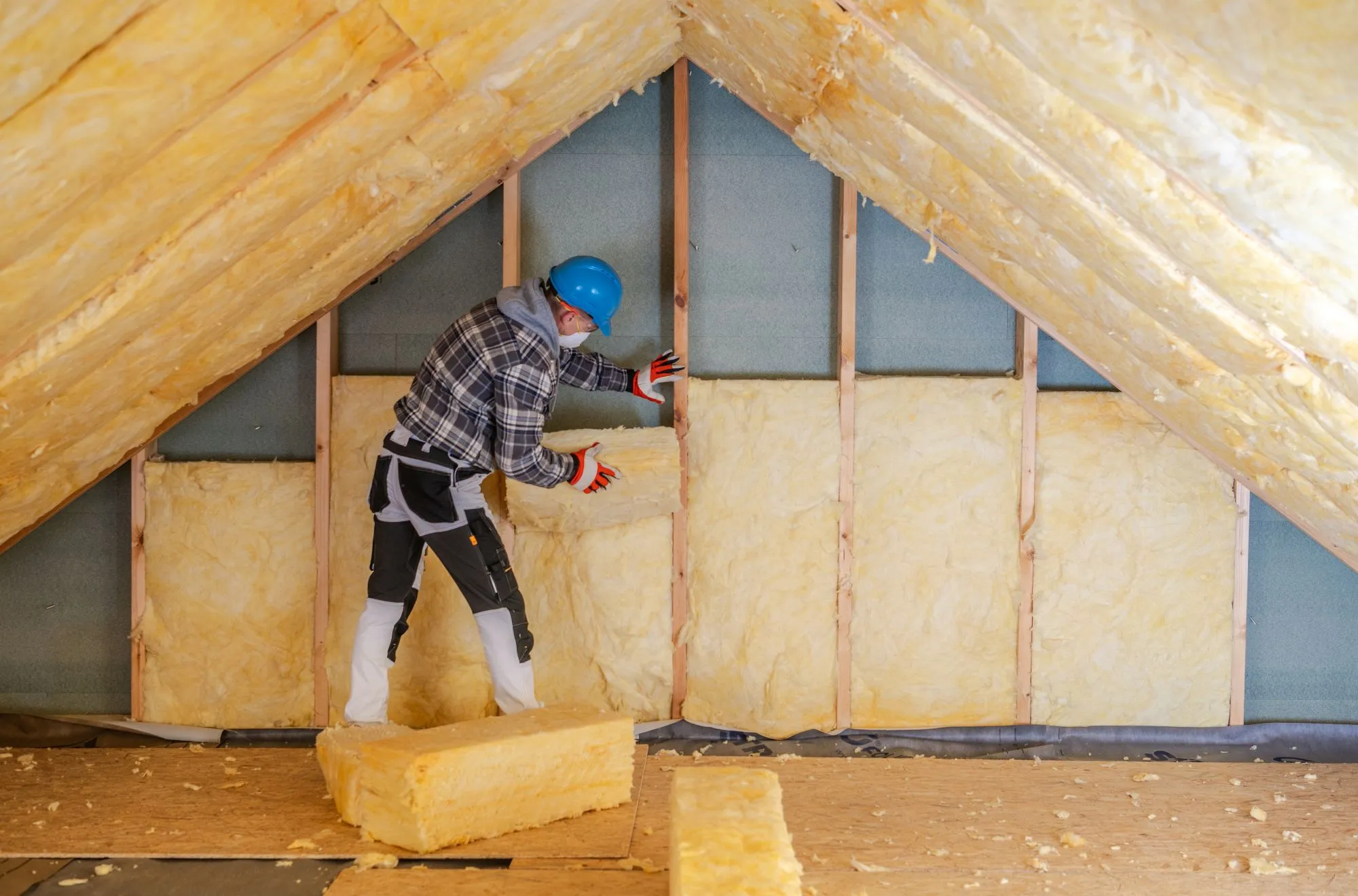
 Poor attic insulation can increase energy bills by allowing heat to leave the home faster during Edmonton’s heating season. However, the bill alone does not prove that insulation is responsible because utility rates, air leakage, heating equipment, and weather also affect costs. Stewart Insulation evaluates the attic condition and existing R-value to determine whether an upgrade is likely to produce a reasonable financial return.
How Energy Escapes Through an Under-Insulated Attic
Heat moves through the ceiling and attic assembly whenever there is a temperature difference between the home and the outdoors. Insulation slows that transfer, but its performance depends on R-value, coverage, condition, and whether air can bypass it through ceiling penetrations.
Winter Heat Loss Patterns
During winter, differences in indoor and outdoor temperature create upward air pressure near the top of the home. Heat then moves through the ceiling by conduction or escapes with conditioned air through openings around attic hatches, wiring, plumbing stacks, exhaust penetrations, and light fixtures.
An under-insulated attic increases conductive heat loss because the ceiling assembly provides less resistance to heat flow. Uneven coverage also creates weak areas where heat escapes faster than it does through the surrounding insulation.
Air leakage can produce significant heat loss even when the attic contains a reasonable insulation depth. A visual attic inspection can identify accessible gaps and penetrations. When the dominant source remains uncertain, blower-door testing or cold-weather thermal imaging can help separate concealed air leakage from conductive loss.
Summer Heat Gain Impact
During summer, sunlight heats the roof and raises the attic temperature above the outdoor temperature. Some of that heat transfers through the insulation and ceiling into the conditioned space, increasing the energy required for cooling.
Additional attic insulation can reduce this transfer, but the financial effect is generally smaller than the winter benefit in Edmonton’s heating-dominated climate. Roof exposure, attic ventilation, air-conditioning use, and the existing insulation level determine whether summer savings materially affect the upgrade decision.
When Insulation Is the Primary Cost Driver
Attic insulation is more likely to be a primary cost driver when the deficiency affects a large portion of the attic, the heating system is operating normally, and consumption remains high after weather and household changes are considered. An attic inspection should confirm the insulation level before the homeowner attributes the increase to one cause.
Homes Below Recommended R-Value
R-value measures resistance to heat flow. Higher values provide greater resistance, although each additional increase produces a smaller improvement than the previous one.
For Edmonton homes, R-50 to R-60 is commonly used as a retrofit performance target. It is not a universal legal requirement for every existing home. Building-code requirements depend on when the home was constructed and whether current work triggers applicable construction standards.
An attic below R-50 is not automatically defective, especially in an older home built under previous requirements. R-value performance is continuous rather than pass or fail. A large difference between the measured level and the target presents a stronger financial case for upgrading than a small shortfall near R-50.
The effective R-value also depends on consistent installation. An attic with adequate average depth can still lose excessive heat if insulation is missing near eaves, displaced around mechanical work, or distributed unevenly across the ceiling.
Older Insulation That Has Settled
Loose-fill insulation can settle over time, reducing its depth and total R-value. Storage activity, trade work, pests, moisture, or movement through the attic can also compress or displace material and create low spots.
Age alone does not mean insulation requires replacement. If the existing material is dry, clean, and suitable to remain in place, a top-up may restore the required depth.
Wet, contaminated, or pest-damaged insulation requires the underlying source to be corrected first. Moisture entry, ventilation defects, roof leaks, or pest access should not remain active beneath new insulation. Removal, replacement, or a top-up can then be considered after the attic is suitable for new work.
When High Bills Are Caused by Something Else
A higher dollar amount does not necessarily mean the home uses more energy. Changes in utility rates, billing periods, and fixed charges can increase the total even when building performance remains unchanged.
Compare the actual units of gas or electricity consumed rather than only the amount owing. Billing periods should cover a similar number of days and comparable heating conditions. Heating degree days, which indicate how far and for how long outdoor temperatures remained below a reference temperature, provide a more reliable weather comparison than calendar dates alone.
Heating equipment can also increase consumption when it is poorly maintained, incorrectly controlled, nearing failure, or operating with inefficient settings. Duct leakage, an unsealed attic hatch, exterior air leaks, and excessive exhaust fan use can raise heating demand without indicating that insulation is the primary issue.
Air sealing can matter more than adding insulation when openings allow conditioned air to bypass the thermal barrier. Accessible penetrations between the living space and attic should be sealed before an insulation top-up where appropriate. However, the work must preserve required soffit, roof, or ridge ventilation pathways so attic airflow is not obstructed.
Household changes can also explain higher consumption. Longer thermostat schedules, increased occupancy, electric heaters, hot-water use, additions, or newly conditioned spaces can raise energy use independently of the attic. When the source remains unclear, a whole-home energy assessment provides a stronger basis for separating attic losses from other variables.
Calculating Whether an Upgrade Makes Financial Sense
Start with the existing attic R-value, the recommended target, the area requiring coverage, and the condition of the insulation. A large gap between current and target performance generally offers more savings potential than adding insulation to an attic already near R-50.
Next, separate space-heating costs from the total utility bill. Water heating, appliances, distribution charges, and fixed fees will not fall simply because the attic receives more insulation. An estimate based on the entire bill will overstate the potential savings.
Expected annual savings should come from a property-specific heat-loss calculation, EnerGuide assessment, or comparable energy model. A generic percentage cannot reliably account for attic size, existing R-value, air leakage, heating efficiency, thermostat settings, weather, and local energy prices.
Simple payback equals the net upgrade cost divided by the estimated annual energy savings. For example, a $4,000 project expected to reduce annual heating costs by $400 has a simple payback of ten years. This is a calculation example, not a typical savings claim.
Net upgrade cost should include installation, removal, air-sealing or ventilation corrections, taxes, and other required attic work, minus any confirmed incentive. A straightforward top-up will therefore have a different financial case than a project requiring removal and remediation.
Simple payback does not account for future energy-price changes, financing costs, or benefits unrelated to direct energy savings. Homeowners should compare the result with their expected ownership period and the diminishing return from adding insulation beyond an already effective level.
There is no reliable universal percentage for how much poor attic insulation increases heating costs. The most defensible estimate comes from measuring the attic, reviewing weather-adjusted energy consumption, and modelling the expected reduction in heat loss. Post-upgrade bills must also be compared using similar weather, occupancy, and thermostat conditions.
Attic Insulation Upgrades with Stewart Insulation
Stewart Insulation provides attic insulation inspections, installations, upgrades, and removal services in Edmonton. An accurate attic assessment considers insulation type, depth, density, compression, coverage, and overall condition before estimating the existing R-value.
The inspection also reviews attic layout, access, and ventilation before a top-up or replacement is recommended. After installation, the team confirms the target depth and completes a final cleanup. This gives homeowners a property-specific scope and price before they decide whether the expected energy savings justify the investment.